


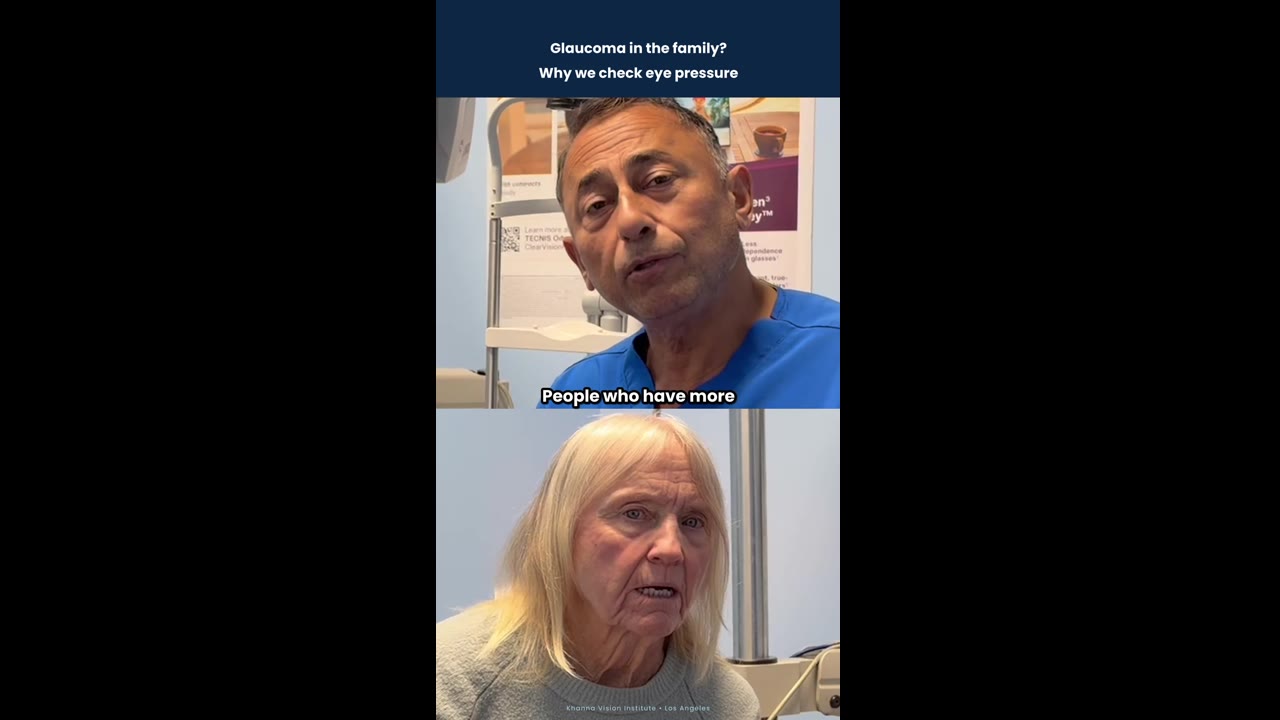
This short is Dr. Khanna teaching, with Joan in the chair a day after PIE: why pressure is checked, and what he does if it rises.
He says people who have more tendency towards glaucoma are more likely to see a pressure rise. Joan's sister has glaucoma, he notes, which can mean a genetic tendency for the angle to get clogged. The sister is not named here. Then he explains what they did when the pressure was high: they leave a small trap door so fluid can come out without going inside the eye, and the wound self-seals.
His words in the clip include “we leave some trap door open” and “the fluid comes out and then self-seals the wound”
That is one patient's experience, not a guarantee for every eye. A pressure check after surgery is part of why the next-day visit matters. What happens for one patient is not a script for every eye.
Why check eye pressure so soon after PIE?
Dr. Khanna explains that some people, including those with a family tendency toward glaucoma, are more likely to see a pressure rise. Checking lets the team treat it if needed.
What is the trap door he mentions?
In the video he describes leaving a small trap door so fluid can come out and bring the pressure down, without going inside the eye, and says the wound self-seals. Ask him at a consult how this applies to you.
How do you start?
Book a free VIP consult with Dr. Khanna at Khanna Vision Institute in Westlake Village or Beverly Hills, or call (310) 482-1240. Video consults are available, and the process takes only a few visits. Distance does not have to be a barrier.
Every eye is different, and results vary. Some patients may still need glasses. No one can promise a specific result. Dr. Khanna will tell you honestly what is realistic after he sees your eyes.
Results vary. Some patients may still need glasses.