

Somewhere after 45, the phone starts drifting farther from your face. Readers pile up in every drawer. Someone mentions monovision: one eye set for far, the other for near. It sounds clever, until you think about everything in between. Dr. Khanna answers the comparison in about fifteen seconds.
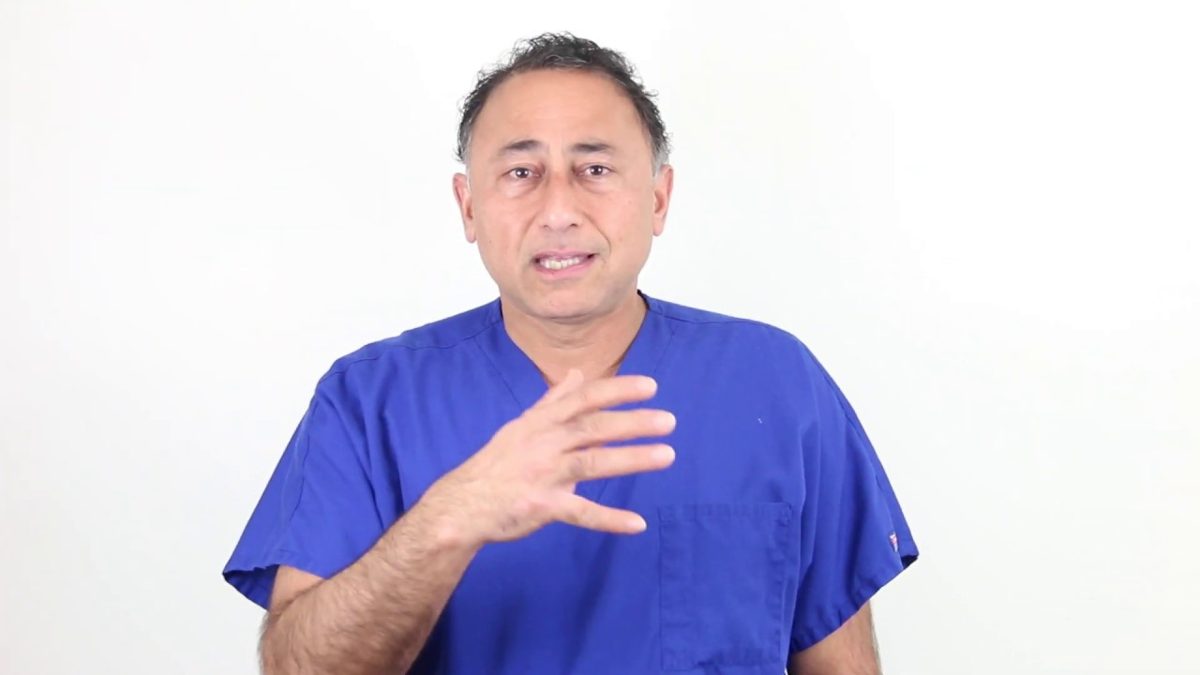
"Monovision, as the name suggests, one eye is far and one eye is near, so middle is a lot of problem." Rajesh Khanna, MD
What is the problem with monovision?
The middle distance. With monovision, Dr. Khanna explains, "one eye is far and one eye is near." That leaves the in-between range, such as a dashboard, a computer screen or a face across the table, without a clear owner. He says that middle "is a lot of problem."
How is PIE different?
PIE stands for presbyopic implants in the eye. Instead of splitting jobs between the eyes, Dr. Khanna says PIE "overcomes this by allowing each eye to see at all distances." Because both eyes work together, he says "binocularity is maintained and there is depth of field." PIE is for people over 45, through cataract surgery or refractive lens content exchange. Our PIE page explains the lens options.
Who should consider PIE?
People over 45 who are tired of reading glasses, or who have been told about monovision and feel unsure. Not everyone is a candidate. Your eye health, your lens and your daily life all matter, and your surgeon will be honest about what to expect.
What should you ask at your evaluation?
- How would monovision and PIE each work for my daily life?
- What range do I use most: far, middle or near?
- Which implant options fit my eyes?
Can you start without a long drive?
Yes. You can begin with a video consultation from home, and the process takes only a few visits. We have two offices. Call Beverly Hills at (310) 482-1240 (9100 Wilshire Blvd, Suite 265E, Beverly Hills, CA 90212) or Westlake Village at (805) 230-2126 (31824 Village Center Rd, Suite F, Westlake Village, CA 91361). We accept PPO plans only. We do not accept HMO plans or Medi-Cal.
Frequently asked questions
What is the difference between PIE and monovision?
Monovision sets one eye for far and one for near. Dr. Khanna explains that PIE lets each eye see at all distances while both eyes keep working together.
Who is PIE for?
PIE is for people over 45, through cataract surgery or refractive lens content exchange. An evaluation decides whether it fits your eyes.
Rajesh Khanna, MD is a board certified ophthalmologist and UCLA clinical instructor, Jules Stein Eye Institute, with 25+ years in practice and 25,000+ procedures.